






More about the aurora australis
+ tips & tricks for aurora chasing!
Discover!
SOLAR MAXIMUM, the best chance to see aurora from mainland Australia.
Catching a big aurora is REALLY rare! That is the reason why an encounter from mainland Australia is special. So, when will the next chance be? We don’t really know, BUT what we do know is that chances are highest during solar maximum.
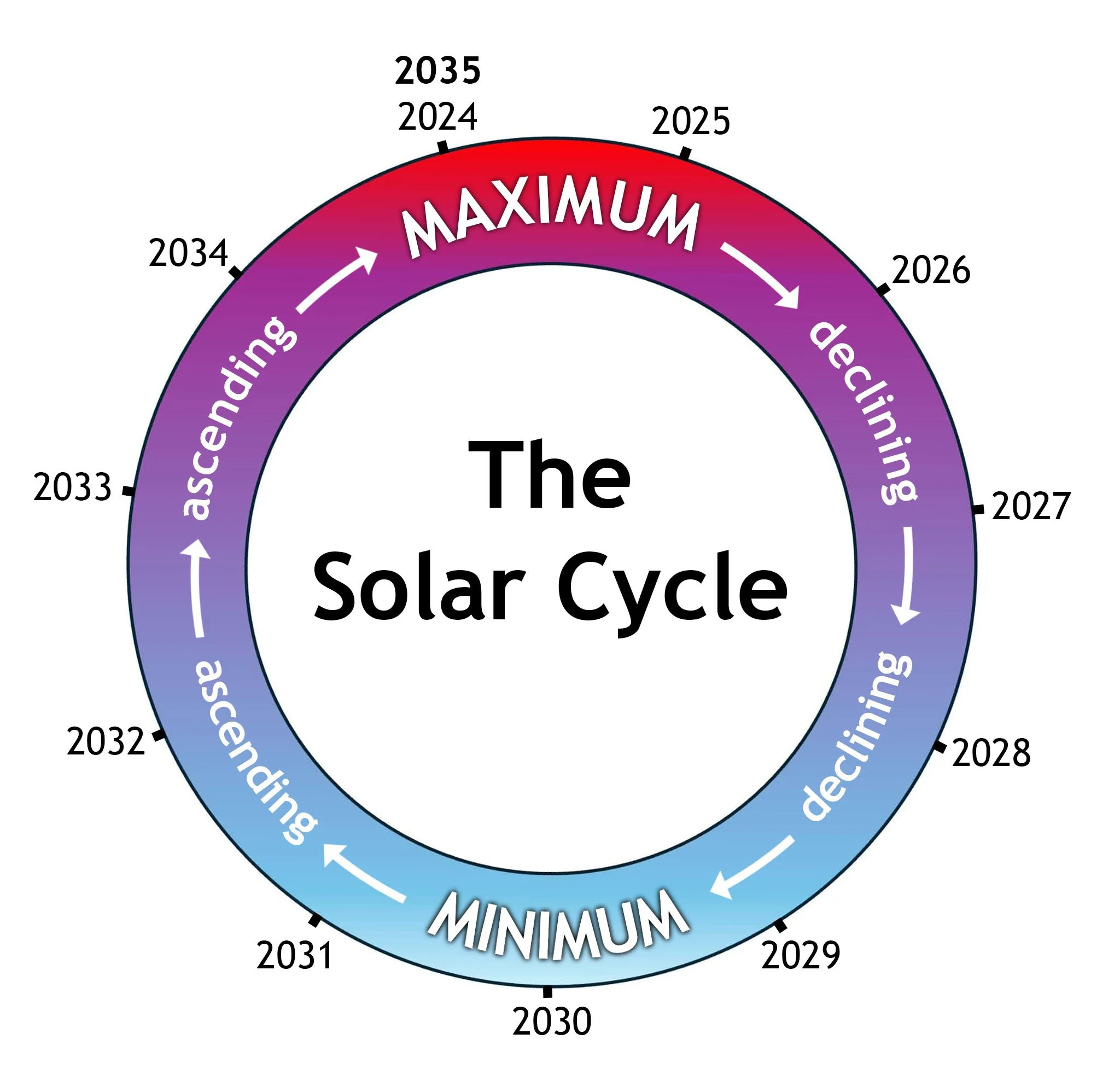
The sun goes through an 11 year cycle. During that cycle there is a super active period called solar maximum, and a very quiet, sleepy period called solar minimum.
On mainland Australia, our best chances to witness an aurora occurs in the year either side of the peak of solar maximum. The most recent solar maximum peaked in October 2024, with big solar storms occurring throughout 2024 and 2025. We are now heading out of solar maximum and back towards solar minimum, with less chances of big auroras occurring. The next solar maximum is expected around the year 2035.
WHAT needs to happen for us to see an aurora?
We learned in the book that to get a REALLY big particle party, we need the Sun to fart in Earth’s direction and for a coronal mass ejection (CME) to come out with that fart. But there are actually many more things that need to go right for the aurora australis to put on a show.
Firstly we need a solar flare and CME to be launched from the Sun towards Earth… there are lots of flares that happen during solar maximum, but the Sun is big and round and most of the CMEs get blown out into space away from Earth.
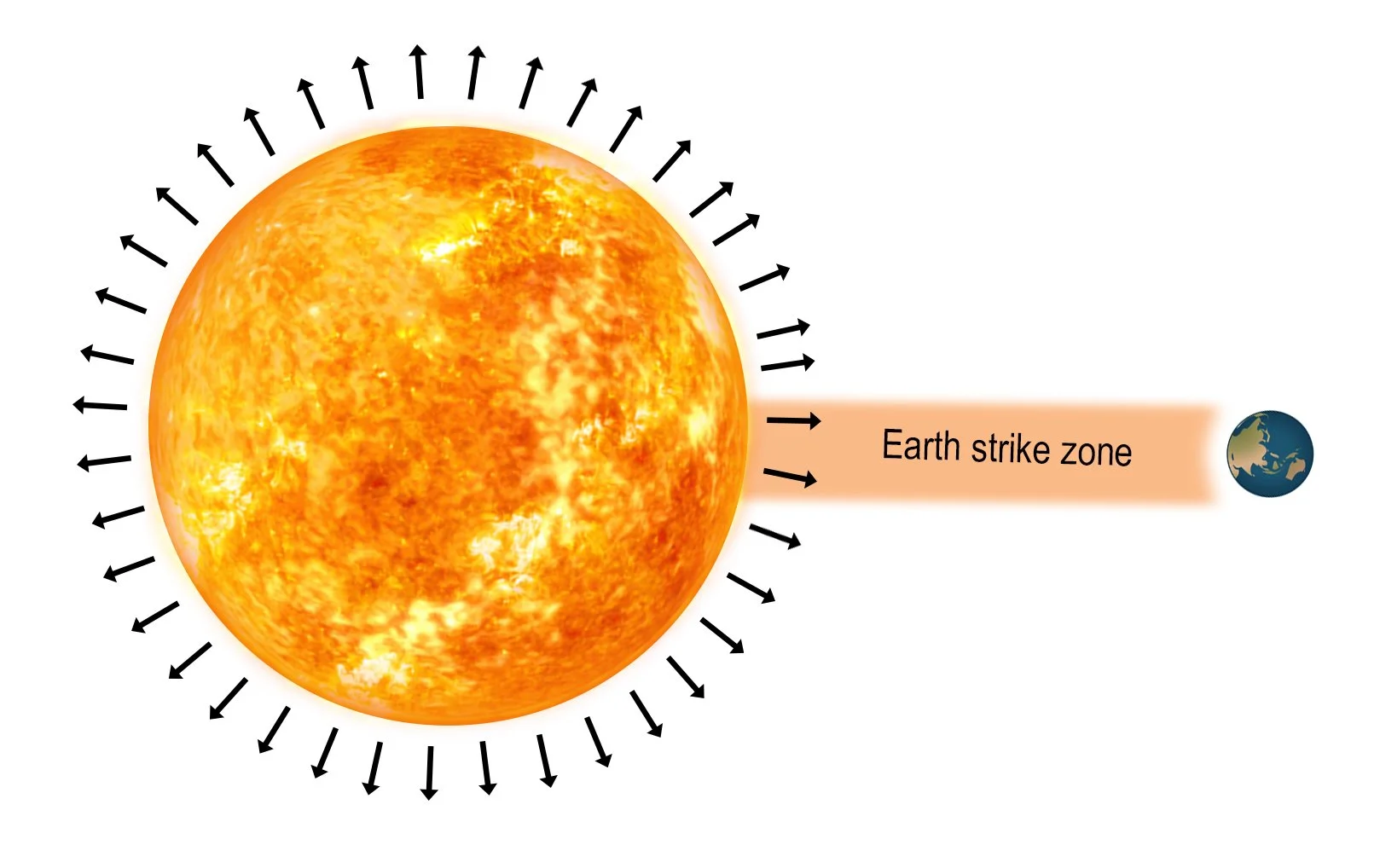
Secondly we need the CME to REACH Earth! When the sun is very active, it can be blowing gas out of many different “holes” its surface all at once, and sometimes we think a CME is going to arrive at Earth, but it is blown off course enroute and never gets here.
Thirdly we need the CME to arrive at night! Particle parties that happen during the day cannot be seen by humans because the sunshine is too bright. Just like the stars in the sky cannot be seen in the daylight, an aurora can only be seen at night.
Then we need the southern sky to be clear. Auroras happen in the outer atmosphere, and just like the stars, you cannot see them through the clouds!
It also helps if the Moon isn’t too big and bright. Whilst a very strong aurora can out-shine the Moon, the bigger and brighter the Moon gets, the more it drowns out the light and colour of an aurora, making it tricky to see.
Finally, we need the arriving sun particles to have a negative magnetic field! Think of this final part like a fridge magnet. Earth has a magnetic field and the Sun particles have a magnetic field too. Have you ever tried to put two magnets together? On one side they stick together but flip them around and they slide apart! A CME can do the exact same thing. If the magnetic field of the incoming sun particles is negative, they get pulled into Earth’s magnetic field and an aurora can occur. However, if the magnetic field of the CME is positive, then they just slide right off.
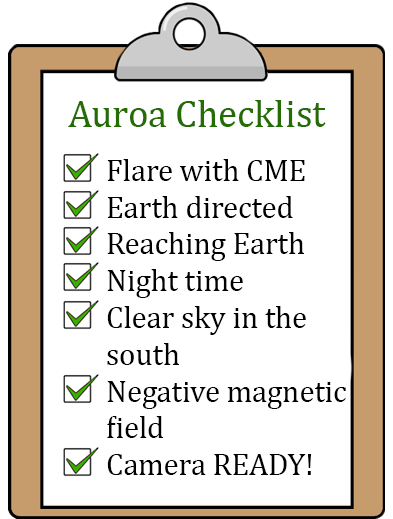
WOW! No wonder it is rare and special.
SO many things that need to go right for a particle party to be experienced.
HOW do I know WHEN an aurora might happen?
It’s important to watch the space weather!
We learn what space weather will soon arrive at Earth when it passes some special space weather satellites surrounding our planet. These special satellites give us a reading of what is incoming, BUT this information is only received around 30 to 60 minutes ahead of it impacting on earth. A CME can take between 18 and 72 hours to arrive, so we must patiently wait for the Space Weather agencies to broadcast a solar storm’s imminent arrival based on the readings from their space weather satellites.
There are some good space weather apps, and our favourite is the Glendale App. The app gives to-the-minute information about what is happening in the sky now, as well as a forecast of what is incoming.
There is a substorm panel on the app with colour themed alert levels. YELLOW alerts and ORANGE alerts are not particularly relevant to mainland Australia. When there is a RED alert it might be worth looking outside. Then there is the exciting PURPLE alert! It is the most important alert level relevant to NSW, Victoria, South Australia and Western Australia! Purple alerts are further rated Major Alert (a good chance to see aurora), then Extreme Alert (an excellent chance to see aurora) and the top level Extreme Alert (Go, go go!!!).
The Glendale app can be downloaded directly from the website https://aurora-alerts.uk/ (note that it is not available from an app store).
There is also an excellent guide here to help you understand more of the highly technical information you are seeing on the app.
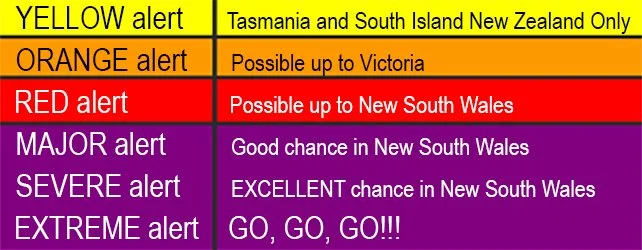
During recent extreme events aurora has been viewed all the way up to the middle of Queensland! So, wherever you are, if there is an EXTREME alert active, it is worth trying to catch a glimpse!!
There are many Facebook groups that issue nightly forecasts and up to date information as events occur.
Aurora Hunters Victoria is a particularly active group and in photographer Emma’s experience, if aurora is visible in Victoria, it is highly likely to also be visible in southern NSW too. As the administrator of that page, Barb Wallace says when the space weather is looking promising, “Don’t get giddy, just get ready!”
Aurora Australis Tasmania is (in our opinion) the absolute best Australian Aurora Facebook page. We love this page for its nightly updates and forecast information. This page also features loads of photos from photographers in Tasmania and all-around Australia to enjoy. Just be aware that Tasmania sees more aurora than mainland Australia does.
WHERE can I see the aurora australis?
During an extreme event, there is a chance to see aurora all the way up into Queensland. But where ever you, in Australia, you MUST be looking south! Remember the aurora particle party happens around the South Pole, so you need to be looking south to see it. There are some tips on how to find south in the Welcoming Aurora book.
You want your southerly view to the horizon to be as clear as possible, so don’t stand with a mountain in front of you, get up on top of that hill! Overlooking a lake or gazing across big open farming fields are both excellent options too.
Find a dark sky lookout. Whilst extreme events might cut through light pollution, you will have the best views of an aurora if you are looking south towards a dark sky zone. As much as you can, get the city lights behind you. Remember, the light of an aurora isn’t very bright to the human eye, so if you can, get away from any human made light. The light pollution map online is an excellent place to look for your nearest dark sky locations.
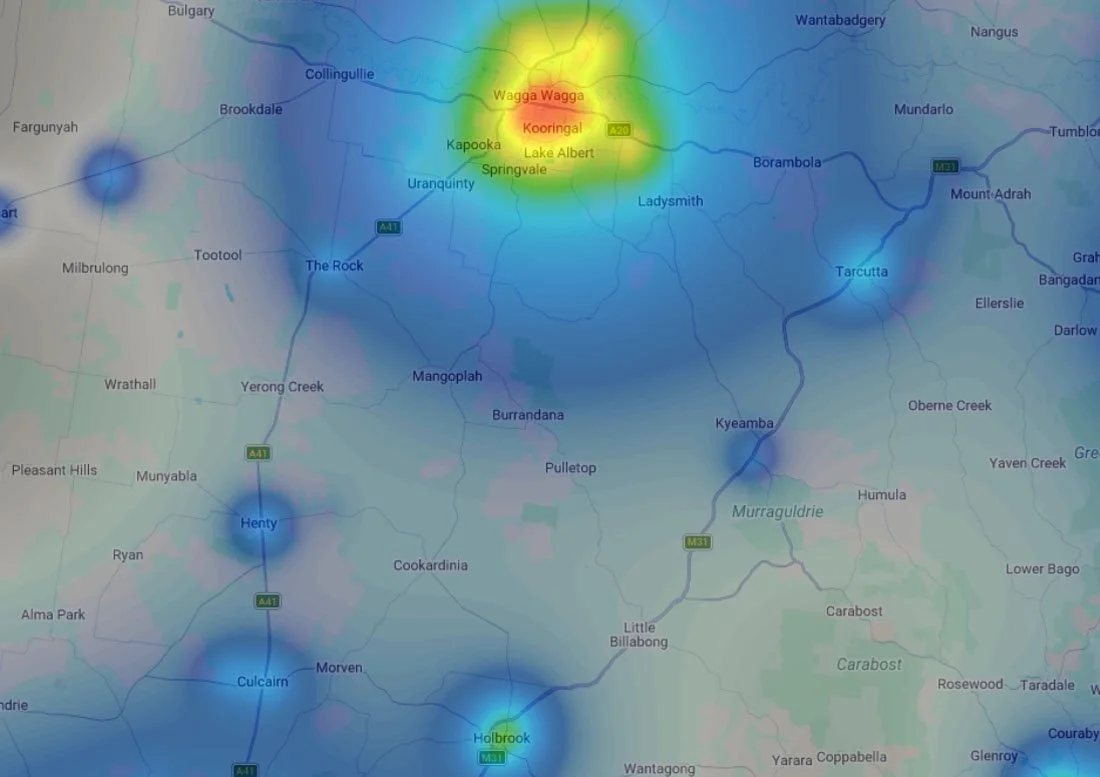
Screenshot from lightpollutionmap.info
HOW do I photograph the southern lights?
Mobile phones
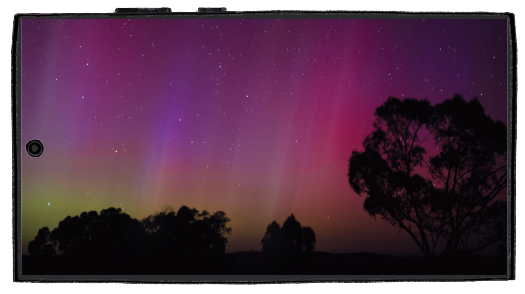
Modern mobile phones are very capable of capturing an aurora.
Turn off the flash and find the settings on your phone that allow a long exposure—around 10 seconds (e.g. enable Night Mode and adjust the exposure on an iPhone).
You also need to keep your phone REALLY still, so use a phone holder or a tripod if you have one or when holding your phone and balance your elbows on something stable (e.g. a fence, car etc).
Cameras
The photographs in the Welcoming Aurora book were all taken by photographer, Emma, on her camera. Here is a guide to the settings she recommends using on a camera with full manual mode (a digital SLR or mirrorless cameras).
Remember to practice, first in the daylight, and then maybe try the milky way on a nice stary night! That way you are ready, and you won't have to think and work quite so hard in the dark under pressure during an aurora event!
Shutter: Start somewhere between 8 and 15 seconds and adjust. The longer you expose, the brighter and more saturated the colours will be. Remember the aurora is slowly moving though, so to catch individual beams you may want to shorten the exposure time.
Aperture: As wide as you can go! F1.8, or 2.4 if your lens is capable of it. If you only have F4, that is okay too, but you’ll need to use a higher ISO and to expose for a longer duration.
ISO: Start around 3200. You may need to dial it up to 6400 if the aurora is not as strong, and you can certainly dial it back to 1600 or even 800 for very strong events.
Focal length: As wide as possible! If you have a zoom lens, zoom all the way out so you are capturing as much of the sky as possible. For primes, something around 14mm or 16mm is ideal.
Focus: Focus on a bright star in the sky, it will be close to infinity, but probably not all the way there.
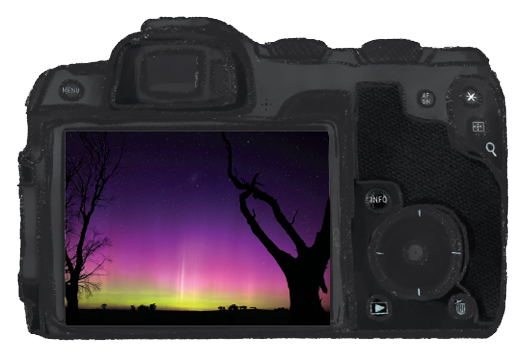
Planning is key! Get familiar with all your equipment before an aurora happens. Selecting a location, charging batteries, working out the proper settings on cameras, and finding appropriate clothing and snacks before the event helps you to have the best aurora chasing experience possible.
WHAT colours will be in the aurora?
The colours of an aurora depends on which gas particles are at the particle party!
The main colours we see come from oxygen particles.
Green aurora: appears lower in the atmosphere where there are lots of oxygen particles.
Red and pink aurora: higher up, where the particles are less dense, the oxygen particles glow red/pink.
We also see yellows and oranges in between as the green and red overlap.
Blue and purple aurora: these colours come from nitrogen particles in the atmosphere.
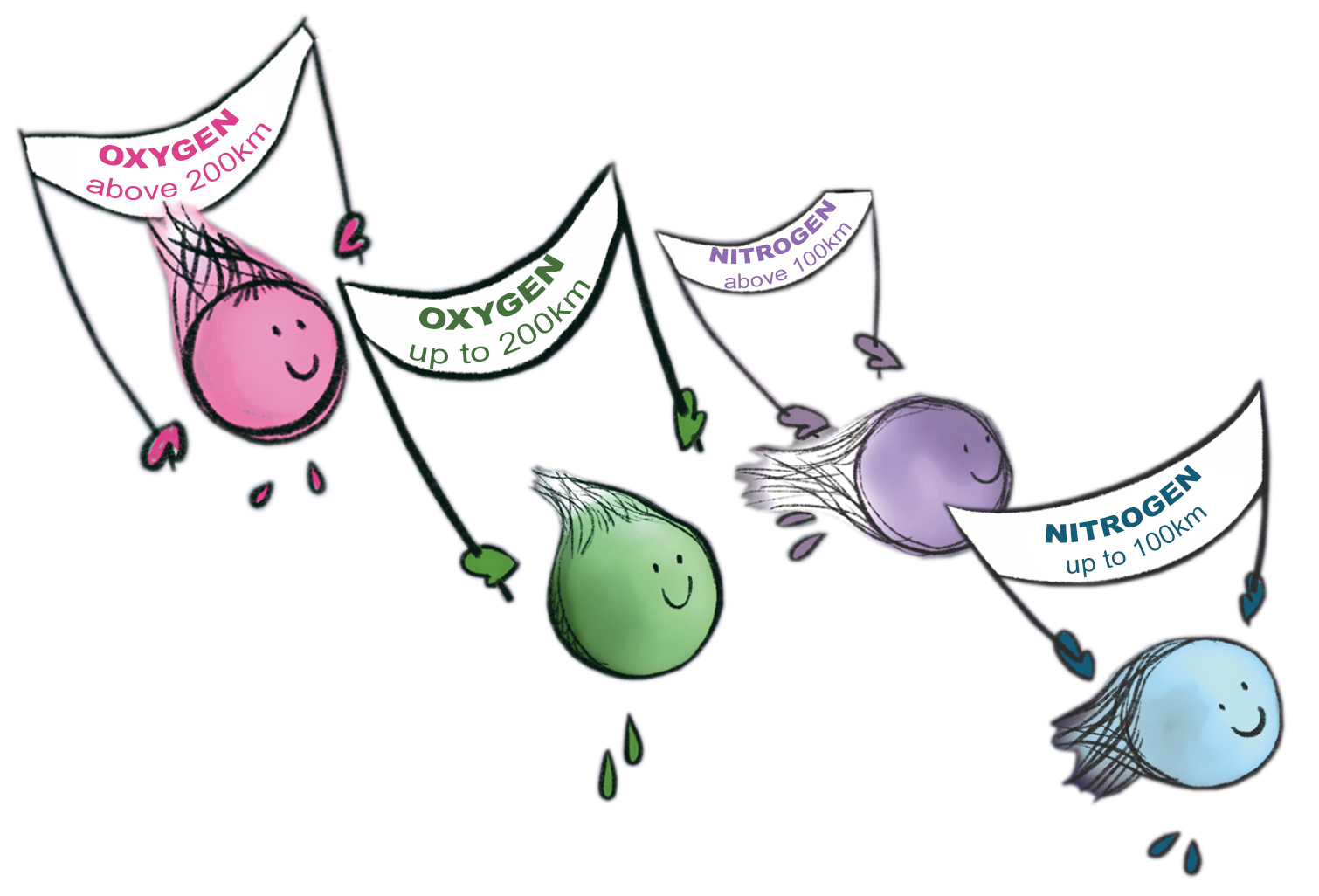
Want a more detailed explanation about aurora colours?
When the energy from solar particles (electrons) excites certain gases in the Earth’s atmosphere, it makes colours appear:
Red aurora: occurs when oxygen atoms are at higher altitudes (200 km above the Earth). They are only visible under intense solar activity due to low oxygen concentrations. Oxygen atoms move from the D state to a P state (there are fewer atoms in the atmosphere bumping into each other, so they have time to emit red light). The red colour is emitted much more slowly. The particles need about 2 minutes to emit the red colour.
Green aurora: occurs when oxygen atoms are at lower heights (altitudes of 100-200 km). They are only visible as green due to higher oxygen concentrations at this level. Oxygen atoms move from the S state to a D state (lower air pressure means fewer oxygen atoms and more time to release a photon before bumping into another atom).
Blue and purple aurora: occurs when ionised nitrogen molecules are at lower altitudes (100 km or below) during intense solar activity (atomic oxygen is uncommon at lower altitudes).
Magenta auroras: are a mixed visual effect of oxygen with lower-level nitrogen near the edges of an aurora
(What causes the different colours of the aurora? An expert explains the electric rainbow. UNSW, Timothy Schmidt, 14 May 2024. Read More)